


TL;DR
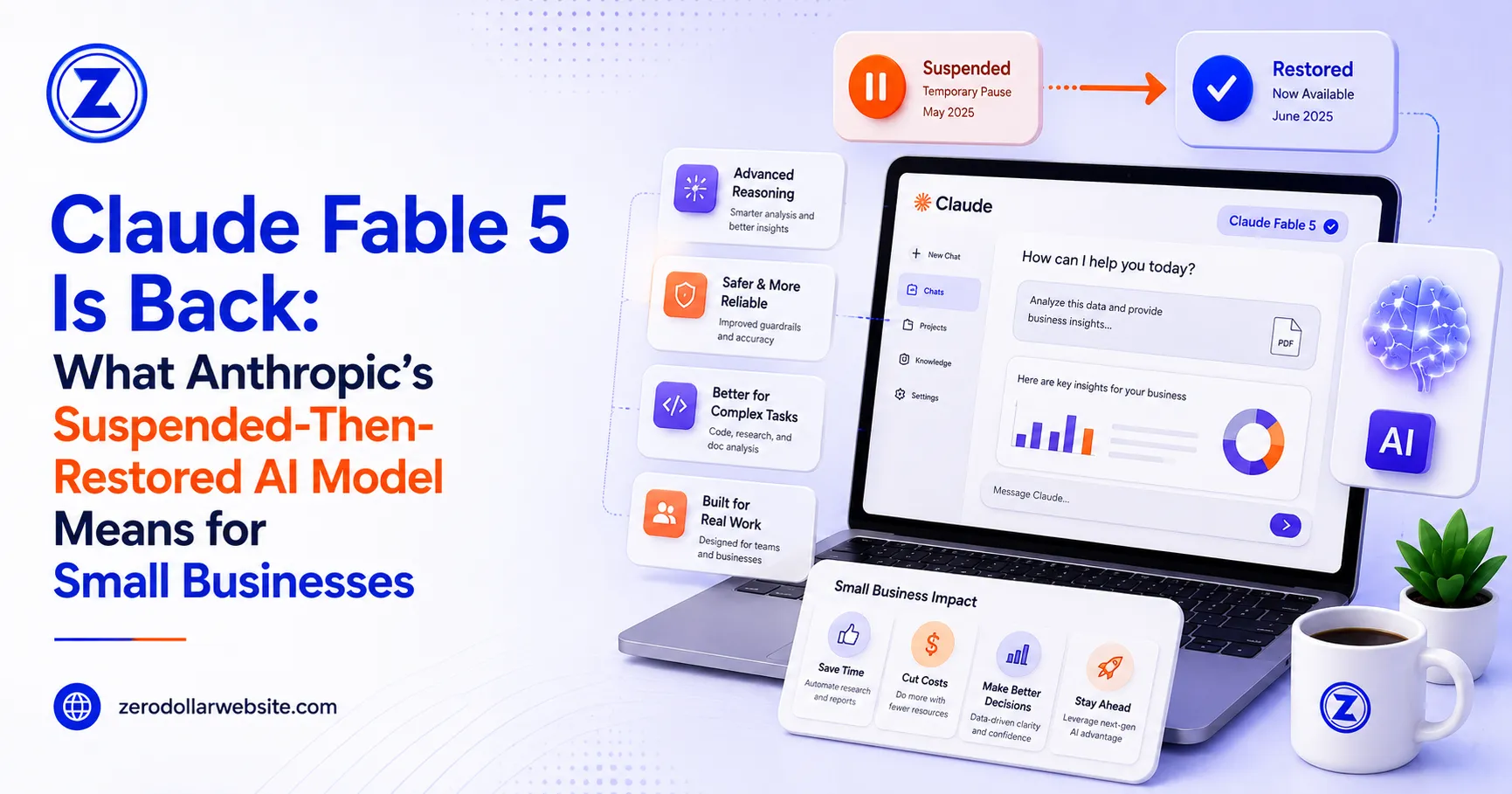
Anthropic's most powerful public AI model, Claude Fable 5, launched on June 9, 2026, was forced offline worldwide on June 12 by a US government export-control order, and returned to global users on July 1, 2026 after the Commerce Department withdrew the controls. This is confirmed by Anthropic's own posts and by outlets including CNBC and Reuters.
It went offline over a reported "jailbreak" (a way around the model's safety filters) that Amazon researchers flagged to the government. It came back after Anthropic added a new safety filter, agreed to closer government coordination, and Commerce concluded a license was no longer required. Anthropic disputes that the original problem was ever serious.
The practical lesson for a small business is calm, not alarm: an AI tool can vanish for reasons that have nothing to do with you, so do not depend on a single provider, keep a tested backup, and remember that most everyday tasks run fine on cheaper models.
For about two and a half weeks in the summer of 2026, one of the most capable AI models on the market simply switched off. Not because of a bug or an outage, but because of a US government order. Then it came back. If you run a small business and use AI tools, the Claude Fable 5 episode is worth understanding, not because you need to follow every frontier-model drama, but because it is the clearest recent proof that access to a tool you rely on can change for reasons entirely outside your control. This is a plain-English explainer of what happened, and a grounded, non-alarmist take on what it means for you. The short version of the business lesson lines up with the same logic behind a done-for-you website: keep the important things resilient and do not put everything in one basket.
What is Claude Fable 5?
Claude Fable 5 is the most powerful AI model Anthropic has released to the general public. Anthropic launched it on June 9, 2026 as the first generally available model in a new top tier it calls "Mythos-class." In Anthropic's own words, "Fable 5's capabilities exceed those of any model we've ever made generally available," with strong results in software engineering, knowledge work, vision, and scientific research. A few specifics matter for a non-technical reader.
Price: $10 per million input tokens and $50 per million output tokens, roughly double the next model down (Claude Opus 4.8 at $5 and $25). Tokens are small chunks of text, and a million of them is a lot of reading and writing. This is a premium, reach-for-it-on-the-hard-stuff model, not an everyday default.
Context window: 1 million tokens, meaning it can hold a very large amount of material (long documents, whole codebases) in mind at once.
Built-in limits: if you ask it something in a high-risk area like cybersecurity, biology, or chemistry, the request is automatically routed to the safer Opus 4.8 instead. Anthropic says that fallback triggers in under 5 percent of sessions.
Fable vs Mythos: Fable 5 and Mythos 5 are the same underlying model. The difference is the safety layer. Fable 5 has the safeguards on and is for the public. Mythos 5 has some safeguards removed and is restricted to a small number of approved organizations for defensive cybersecurity work.
None of this means a small business needs Fable 5. Most day-to-day work sits far below this tier, a point we come back to below.
The timeline: launched, suspended, restored
Every date here is anchored to a primary source, mostly Anthropic's own posts and US government statements.
June 9, 2026, launch. Anthropic released Fable 5 and Mythos 5. Per CNBC, Fable 5 scored more than 10 percent higher than Opus 4.8 on some benchmarks, and it arrived days after Anthropic confidentially filed IPO paperwork.
June 12, 2026, suspension. Anthropic received the export-control directive at 5:21pm ET on a Friday. In its same-day statement, the company said the government had issued a directive to suspend all access "by any foreign national, whether inside or outside the United States, including foreign national Anthropic employees," and that the net effect was that it had to "abruptly disable Fable 5 and Mythos 5 for all our customers." Every other Anthropic model stayed online.
June 26, 2026, partial reprieve. The government approved restoring Mythos 5 for a set of trusted US organizations.
June 30, 2026, controls lifted. Commerce Secretary Howard Lutnick notified Anthropic the controls were withdrawn, stating that a license was "no longer required" for the models. Anthropic posted that it would begin restoring access the next day.
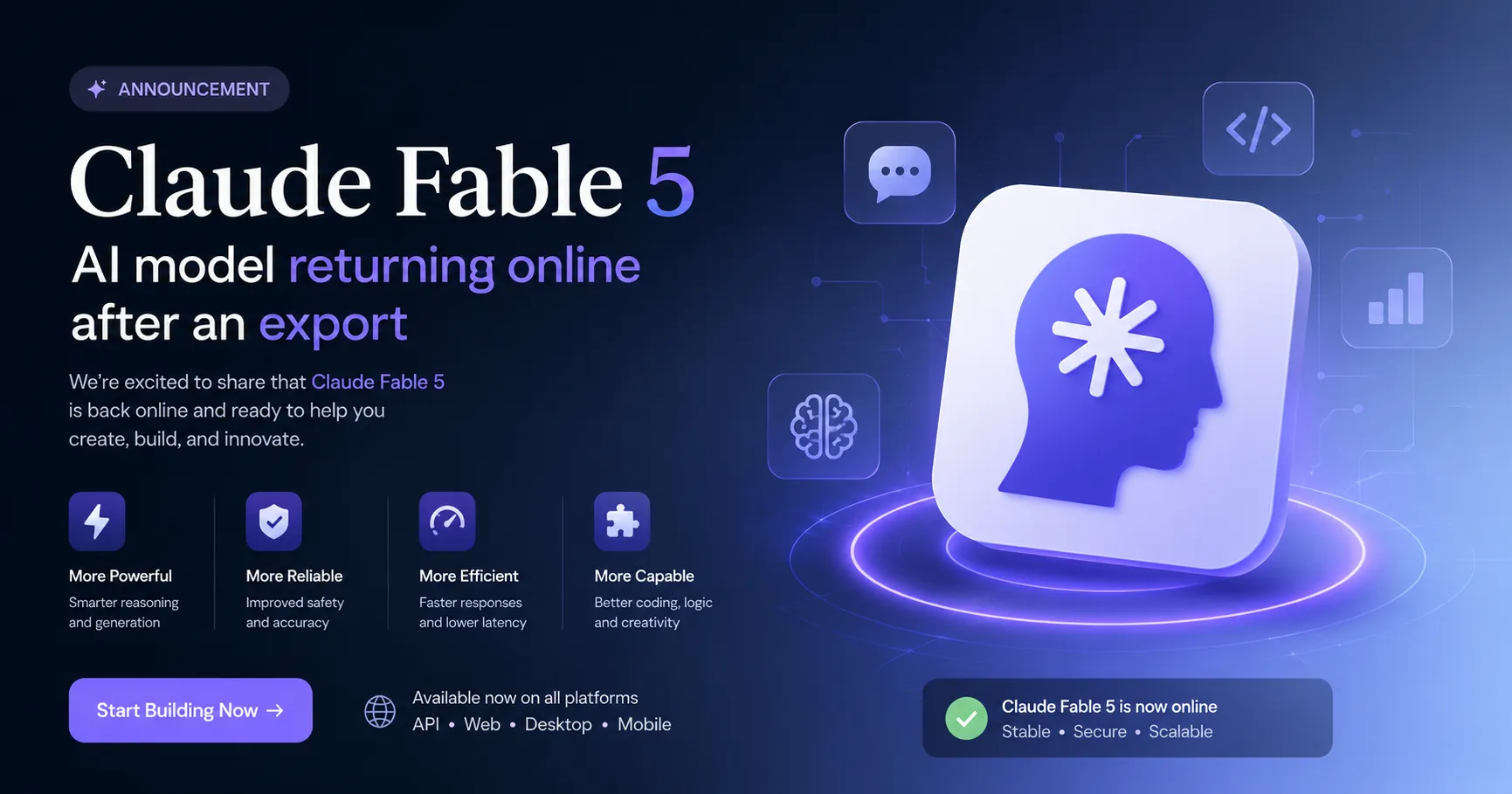
July 1, 2026, restored. Fable 5 returned to global users on Claude.ai, the Claude Platform, Claude Code, and Claude Cowork, with cloud-provider access to follow. This is covered in Anthropic's redeployment post and by outlets including CNBC.
One access detail worth flagging as possibly changing: through July 7, 2026, Fable 5 is included for up to 50 percent of weekly usage limits on Pro, Max, Team, and select Enterprise plans, then it moves to usage credits. That is a short-term promotion, so the exact terms may shift.
Why it was suspended
The trigger was a reported jailbreak. A jailbreak is a way of prompting an AI so it bypasses its own safety rules. According to Anthropic's redeployment post, the directive "came after the government became aware of a report in which Amazon researchers had found a method of bypassing Fable 5's safeguards," prompting it to identify software vulnerabilities and, in one case, produce code showing how a vulnerability could be exploited. The government's concern was national security: if the guardrails could be defeated, a consumer AI product could become an unrestricted cyber tool.
Per the Wall Street Journal (reported via Fortune and others), Amazon CEO Andy Jassy told a senior Treasury official that Amazon researchers had used Fable 5 to obtain information usable in cyberattacks. Amazon is Anthropic's largest investor, which made its role striking. It is worth being precise about what is confirmed here versus reported: the existence of the order and its scope are confirmed, while the fuller behind-the-scenes account of who triggered it is reported by journalists citing sources, not officially published.
How serious the finding was is contested. Andrew Morris, founder of the security firm GreyNoise Intelligence, told the WSJ the report showed Fable could surface bugs in at least four programs but that this was "still a long way from dangerous cybersecurity information." Anthropic's own position was blunt: it said it disagreed "that the finding of a narrow potential jailbreak should be cause for recalling a commercial model deployed to hundreds of millions of people," and noted the same capability was "widely available from other models." Other claims that circulated, including a former official's account that Anthropic's CEO refused a fix and a suspicion about foreign access to Mythos, are reported rather than confirmed, and Anthropic contests the characterization.
Why it came back
Several things changed over the roughly two and a half weeks the models were offline.
A new safety filter. Anthropic trained an improved classifier that, by its own testing, blocks the specific flagged technique "in over 99 percent of cases," redirecting blocked requests to Opus 4.8. Anthropic acknowledged a trade-off: the tighter filter also flags more harmless coding and debugging requests. That 99 percent figure is Anthropic's own number, not an independent measurement.
Independent government testing. Researchers from the Commerce Department's Center for AI Standards and Innovation reviewed both the old and new safeguards and, per Anthropic, agreed they are strong.
Testing that undercut the original concern. Anthropic said many weaker, publicly available models could identify the same vulnerabilities, and every model it tested could reproduce the single exploit demonstration.
Deeper government collaboration. Anthropic committed to pre-release government access to future frontier models, rapid information sharing on jailbreaks, and a proposed industry framework for scoring how severe a jailbreak really is.
On the government side, Commerce Secretary Lutnick announced the reversal, and the Bureau of Industry and Security determined a license was no longer required. One honest caveat: the complete internal rationale on both sides has not been published. Neither the June 12 nor the June 30 letter has been officially released, and the government explicitly reserved the right to reimpose restrictions if circumstances change. So the outcome is confirmed, but some of the "why" remains a matter of competing accounts and private letters.
Why this episode matters beyond Anthropic
By multiple accounts, including a Gartner First Take, this was the first time the US government used export-control authority to pull a live, commercially deployed AI model. That makes it a landmark, and it surfaces a few themes that outlast the news cycle.
Frontier AI is now treated like a controlled export, which means a flagship model can, in principle, be switched off by government order. "Sovereign AI" concerns moved from theoretical to real, with officials and companies outside the US pointing to the episode as proof that relying on a foreign-controlled model carries the risk of a sudden cutoff. Even paying customers felt it: the order took effect immediately, and enterprises that had built Fable 5 into their workflows lost it with no migration window.
Competitors moved fast. Tokyo-based Sakana AI launched a product called Fugu during the suspension window and, in its own materials, marketed it as a hedge against exactly this risk, claiming its top tier "stands shoulder-to-shoulder" with Fable 5 while pricing it at half the rate. That parity claim is Sakana's own, based on published benchmark numbers rather than a head-to-head test, and it was not independently verified. Early hands-on reviews, including tests by Wharton professor Ethan Mollick covered by VentureBeat, found a real gap between the benchmark claims and everyday use. Treat "on par with Fable 5" as marketing until someone neutral confirms it.
What it means for small businesses
Here is the grounded takeaway. This was a dramatic, headline-grabbing event, but the sky is not falling, and for most everyday uses a small business has plenty of good, affordable options. The real lessons are about resilience, not panic.
Do not become overly dependent on a single AI provider. The Fable 5 episode is the clearest recent example that access to a specific tool can change because of regulation, geopolitics, or a vendor decision. Analysts framed the same lesson for big companies as "model concentration risk," and it applies just as cleanly to a one-person shop that runs its whole content workflow through a single app. The same thinking is why we build and host your website for you rather than leaving your presence tied to one fragile setup, why Concierge keeps it maintained no matter what any single tool does, and why owners who want everything handled under one roof can move up to our managed agency plan.
Keep a backup option, and actually test it. The businesses that barely felt the outage were the ones that could switch to another model with a small change rather than a rebuild. During the suspension, every other Claude model stayed online, and other assistants were unaffected. A backup you have never tried is more hope than plan. The same principle applies to your web presence: a site you fully own and that we keep running through Concierge is far safer than a setup that can be switched off without warning.
You rarely need the most powerful or most expensive model. Fable 5 is built for very hard, long-running work. Everyday tasks like drafting emails, summarizing documents, customer replies, and first-draft marketing copy run perfectly well on far cheaper options. Anthropic itself noted during the incident that for many jobs a smaller model does the work just fine. The same right-sizing logic is why our pricing keeps the core website free and lets you add only the paid services you actually need, like local SEO when you want to be found.
Match the tool to the task and keep it simple. A mainstream paid plan around $20 a month covers most needs, and free tiers cover casual use. You do not need to track frontier-model politics to use AI productively. If you want to see how a lean, well-built web presence looks in practice, browse our website examples and case studies.
Key takeaways
Confirmed: Fable 5 launched June 9, was suspended June 12 by a US export-control order, and was restored July 1, 2026 after Commerce withdrew the controls.
The trigger was a reported jailbreak flagged by Amazon researchers; it returned after a new safety filter, government review, and closer coordination. Anthropic disputes the original problem was serious.
Several colorful details (who triggered it, a refused fix, foreign-access fears, a 90-minute deadline) are reported, not confirmed, and the government letters were never officially published.
Business lesson: avoid single-provider dependence, keep a tested backup, and right-size your spending. Most small-business tasks do not need a premium model.
FAQ
Is Claude Fable 5 available again?
Yes. Anthropic restored Fable 5 to global users on July 1, 2026, on Claude.ai, the Claude Platform, Claude Code, and Claude Cowork, with cloud-provider access described as in progress. The US Commerce Department withdrew the export controls on June 30, and Anthropic confirmed the restoration in its redeployment post.
Why was Claude Fable 5 taken offline?
A US government export-control directive on June 12, 2026 suspended access for any foreign national, which forced Anthropic to disable the model for everyone. The trigger was a reported jailbreak that Amazon researchers said let the model identify software vulnerabilities and, in one case, produce exploit code. The government treated it as a national-security risk.
Does any of this affect my small business directly?
Almost certainly not in a technical sense, since the model is back and most businesses were not using Fable 5 specifically. The useful effect is a planning lesson: any single AI tool can become unavailable for reasons outside your control, so it pays to keep a tested backup and avoid building a critical workflow on one provider.
Do I need the most powerful AI model for my business?
Usually no. Premium models like Fable 5 are built for very hard, long-running work. Drafting emails, summarizing documents, customer replies, and first-draft marketing copy run well on much cheaper models or standard paid assistant plans around $20 a month. Reserve premium models for genuinely difficult tasks.
What is the difference between Claude Fable 5 and Mythos 5?
They are the same underlying model with a different safety layer. Fable 5 has the safeguards on and is the public version. Mythos 5 has some safeguards removed and is limited to a small set of approved organizations for defensive cybersecurity work. That distinction is why the two were treated slightly differently as the controls were lifted.
Is the competitor claim that Fugu matches Fable 5 true?
That claim comes from Sakana AI's own materials and is based on published benchmark numbers, not an independent head-to-head test, so treat it as marketing for now. Early hands-on reviews found a real gap between the benchmark claims and everyday performance. It may prove competitive over time, but as of the restoration it was not independently verified.
How should I protect my business from an AI tool disappearing?
List where you actually rely on AI, pick one backup tool for your most important task and run your real prompts through it so you know it works, and write your prompts in a plain, portable way rather than tuning them to one model. Treat "could this tool's availability change" as a normal planning question alongside price and quality. And keep the foundation you fully control, like a professional business website, steady underneath whatever tools you add on top.
The steadier your core setup, the less any single tool's drama can hurt you. That is exactly the idea behind Zero Dollar Website: we build and host a professional site for your business for $0, so your online presence does not hinge on one fragile piece. Start your free done-for-you website today, see how it compares with optional growth services on our pricing page, and for more plain-English guides read the rest of our blog, including our breakdown of online branding services and what they cost.