

TL;DR
Online branding is the full identity your business projects across every digital touchpoint: website, social profiles, visuals, and voice. A logo is one piece, not the whole thing.
In 2026 the price runs from roughly $20 for a do-it-yourself logo tool to $250,000 and up for a global agency. Most small and mid-size businesses that want a real identity land between $2,000 and $30,000.
The headline statistics (revenue up 23 to 33 percent, a signature color lifting recognition by up to 80 percent) trace to real sources but come with caveats. The revenue numbers are vendor self-reported, and the color figure is widely misattributed.
Price predicts value less than process does. The providers worth paying do strategy before design, hand over brand guidelines, and understand digital.
Branding is an optional paid service at Zero Dollar Website. The website itself is free, so the brand has a place to live the moment it is ready.
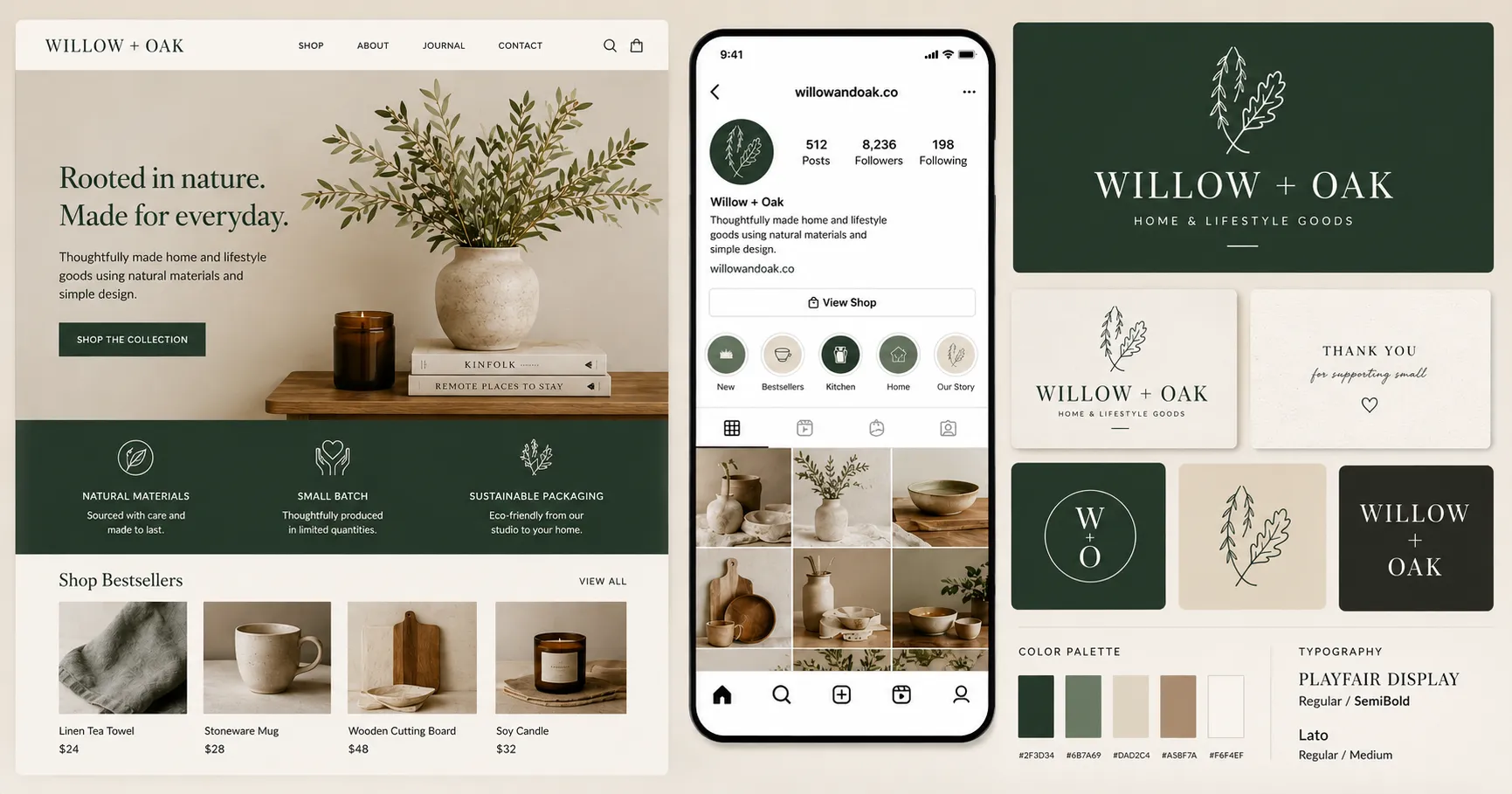
Plenty of owners come to branding thinking they are buying a logo. What they actually need is an identity that holds together everywhere a customer meets them, and the gap between those two things is where most branding budgets get wasted. This guide covers what online branding includes in 2026, what each tier really costs, which famous statistics hold up, and how to pick a partner without overpaying. At Zero Dollar Website we build and host your done-for-you website at no cost, and a clear brand is what makes that site convert.
What online branding actually means
Three words get tangled together constantly, and untangling them saves real money. Branding is the whole identity and perception of your business. A logo is one visual asset inside it. Marketing is how you promote the brand once it exists. Confuse them and you buy the wrong thing at the wrong stage.
Online branding, sometimes called digital branding, is the work of building and managing that identity across digital channels: your website, your social presence, your content, your visual system (logo, colors, type), and your tone of voice. The goal is to show up the same way, recognizably, everywhere a customer finds you online. For a Zero Dollar Website client, the website we build for free is the anchor everything else points back to. Done well, branding drives differentiation, trust, recognition, loyalty, and the ability to charge more without losing the sale. Several widely shared statistics back this up, though it pays to know where each one comes from.
The branding statistics, with the fine print
You will see the same handful of numbers across every branding sales page. Some are sturdier than others. Here is the honest version.
"Consistent branding increases revenue by 23 to 33 percent." This pair comes from Lucidpress (now Marq) and its "State of Brand Consistency" reports, the 23 percent from the 2016 edition with Demand Metric and the 33 percent from 2019. Per the company's December 2, 2019 release via PR Newswire, the latest report found consistent branding can increase revenue by 33 percent, based on a survey of over 200 organizations. The caveat: these are self-reported survey estimates (vendor-reported) from a company that sells brand-consistency software, with a small sample. Treat them as directional.
"A signature color can boost recognition by up to 80 percent." The "up to 80 percent" line traces most often to a Loyola University (Maryland) color study, circulated widely but predating 2020. The original research was really about color helping people read and process information, not brand recognition. A separate Reboot Online survey produced a similar headline, but that reflected how many people recognized Starbucks by its green alone, not a universal rule. Useful as a talking point, weak as a law (vendor-reported and widely misattributed).
The trust data is the stronger evidence. Per the 2019 Edelman Trust Barometer special report "In Brands We Trust?" (16,000 people across 8 countries), being able to trust the brand to do what is right is now a major purchase consideration at 81 percent, trailing only quality, convenience, and value. And per Capital One Shopping Research's 2024 branding roundup, 87 percent of consumers say they will pay more for products from a trusted brand.
The takeaway: branding clearly pays, but the flashiest numbers are softer than they look. Build the case on the trust data and treat the rest as direction, not proof.
What's included in online branding services
Services split into one-time foundational work and ongoing management. The foundational pieces:
Brand strategy and discovery: market and competitor research, audience definition, positioning, mission and values, a messaging framework, the value proposition, and brand personality.
Visual identity: a primary logo plus variations, a color palette, typography, imagery style, iconography, and the brand guidelines that tie it together.
Verbal identity: naming, tagline, core messaging, tone of voice, and copywriting.
Digital presence and assets: website branding, social profile branding, email signatures, ad and pitch deck templates, favicon, and app icon. The website surface is where Zero Dollar Website starts, since your free done-for-you site is built with your identity applied directly.
Brand collateral: business cards, letterhead, brochures, and flyers.
Brand guidelines document: the deliverable that keeps everything consistent across teams and vendors. Leave this out and you are not really selling a brand.
The ongoing pieces are content and social branding (templates, content strategy, branded graphics) and brand management (consistency, audits, refreshes, and social). That is the surface our optional marketing service covers once the foundation is set.
If all you walk away with is a logo file and no documented system, you have a graphic, not a brand. The work has to land on the website, the profiles, and the templates to earn its keep. See the standard on the website examples page.
Types of branding services and how they are sold
Engagements come in a few shapes: full brand identity packages (strategy plus visual and verbal identity plus guidelines), logo or visual identity packages (cheaper, design-led, light on strategy), brand strategy consulting, a rebrand or refresh, ongoing retainers for consistency and social, and the DIY-to-agency spectrum from self-serve software to a full team.
Stage decides the right pick. A founder still testing whether the offer sells should not buy a $25,000 identity package the same week. Once the selling is real, a weak brand starts quietly costing you, usually showing up first in how well your landing pages convert, a connection we dug into in our landing page design tips guide.
What online branding costs in 2026
Every figure below is an estimate that shifts with scope, provider, and location. Agencies in lower-cost regions often price under US and UK shops for comparable work.
Logo design: DIY and AI tools and marketplace gigs can be tens of dollars, freelancers commonly $300 to $3,000, agencies $5,000 and up, top-tier custom work past $50,000.
DIY tools: per Looka's published 2026 pricing, a Basic Logo is $20 (one-time PNG), a Premium Logo is $65 (vector files plus full ownership), a Brand Kit subscription is $96 a year, and Brand Kit Web is $129 a year (adds an AI-generated website).
Freelancers and marketplaces: per 99designs' published tiers, logo contests run $299 to $1,299, and logo plus brand identity packs run $599 to $2,499.
Full brand identity packages: small and mid agencies and senior freelancers commonly $5,000 to $25,000, comprehensive work $20,000 to $100,000 and up, global agencies past $100,000.
Brand strategy consulting: roughly $50 to $300 an hour for freelancers and $150 to $500 at agencies, with project work starting near $2,000 and climbing past $25,000.
Rebranding: a small business refresh lands in the low tens of thousands, a comprehensive rebrand $20,000 to $100,000, and large global rebrands $250,000 into seven figures.
Ongoing retainers: small business $500 to $2,500 a month, mid-market $2,000 to $5,000, enterprise $5,000 to $25,000 and up.
The price tiers at a glance
Tier | Typical cost | What you get |
|---|---|---|
DIY tools | $20 to $130 | AI or template logo, basic brand kit, social templates. No strategy. Can look generic. |
Freelancer or marketplace | $300 to $3,000 | Custom logo, basic visual identity, limited strategy. |
Small or mid agency | $5,000 to $25,000 | Strategy, full visual and verbal identity, brand guidelines, collateral. |
Premium or enterprise agency | $25,000 to $250,000+ | Deep research, positioning, naming, full systems, rollout, global scale. |
For most small businesses that have started selling, the $5,000 to $15,000 window buys the right mix of polish and durability, and a vetted freelancer can lay a foundation for less. Because the website build is free with us, that branding budget stretches further. See how the $0 site sits next to paid services on the pricing page.
How to choose an online branding partner
The filter is the same whether the team is around the corner or across the world. Look for a strategy-first process rather than logos in a vacuum, a clear methodology with named phases, a portfolio that shows outcomes and not just visuals, defined deliverables, and a genuine grasp of digital.
The red flags are just as clear: suspiciously cheap pricing, no strategy or discovery phase, no defined process, no brand guidelines deliverable, a promise of a full identity in a few weeks, and no support after delivery. Get the scope, the deliverables, the revision count, the timeline, and the rights assignment in writing before money moves.
The ROI case for branding
Branding is an investment rather than a line-item cost. A strong, consistent brand compounds over time in recognition, trust, conversions, pricing power, and loyalty. A weak or scattered one quietly bleeds sales and pushes your marketing spend higher to compensate. The trust data makes the point: when 81 percent of consumers say they must trust a brand before buying (Edelman, 2019) and 87 percent say they will pay more for one they trust (Capital One Shopping, 2024), recognition translates into pricing power and repeat business. That recognition also has to be reinforced once a visitor lands, which is what our optional marketing service keeps tight.
What the branding process looks like
A typical engagement runs in order: discovery, research, strategy, identity design, brand guidelines, rollout, then ongoing management. A mid-market full-identity project usually takes about 8 to 16 weeks. The point where most projects either compound or leak is the handoff to delivery, when the identity has to land on the website, the profiles, and the content. Build that handoff into the scope.
Common branding mistakes to avoid
The recurring ones: letting the brand look different on every channel, choosing the cheapest option after you have started selling, skipping strategy, walking away with no brand guidelines, copying a competitor instead of differentiating, and never refreshing the brand as the business grows.
How branding fits the Zero Dollar Website model
Here is where our approach differs from a traditional agency. The website is free. We build and host your done-for-you website at no cost, and branding, marketing, SEO, apps, and Concierge are optional paid services you add only when they earn their place. That reshapes how you sequence the spend.
Decide what you need before you shop. A quick logo, a full identity, and ongoing management are three different purchases. Buying a $25,000 package before the offer is validated is the most expensive mistake we see.
Match the tier to the stage. Pre-revenue, a DIY tool or freelancer is fine. Once you are selling, invest in a real identity package with strategy and guidelines. The signal to upgrade: when amateur branding is visibly costing you leads or conversions.
Shortlist on process, not portfolio looks, and require brand guidelines as a deliverable.
Phase the spend if budget is tight. Strategy first, then visuals, then collateral.
Above all, make sure the brand lands on the digital surface. A brand that lives only in a PDF is half a brand. With us, the free website gives it a home immediately, and our optional marketing and local SEO services push it out from there. If you would rather bundle everything into one managed plan, the older subscription model still lives on the agency page, and Concierge keeps the brand consistent as you grow. Real outcomes appear in our case studies.
Key takeaways
Online branding is the identity and the digital surface it lives on. The logo is one piece. Strategy and guidelines separate a real brand from a polished file.
2026 cost bands: DIY $20 to $130, freelancer $300 to $3,000, small or mid agency $5,000 to $25,000, premium or enterprise $25,000 to $250,000-plus, retainers $500 to $25,000-plus a month.
The most-cited stats are softer than they look. The 23 to 33 percent revenue figure is vendor self-report and the 80 percent color stat is widely misattributed, while the Edelman and Capital One Shopping figures are stronger.
Strategy-first process and brand guidelines as a hard deliverable are the two non-negotiables.
At Zero Dollar Website the site is free, so the brand has a home from day one and branding stays an optional paid service you add when it pays.
FAQ
What is the difference between branding, marketing, and a logo?
Branding is the total identity. A logo is one visual asset inside it. Marketing is how you promote the brand once it exists. Mixing them up is a major source of branding overspend.
How much should I spend on branding in 2026?
Match the tier to the stage. DIY tools at $20 to $130 suit testing, a freelancer at $300 to $3,000 suits early stage, a full identity package at $5,000 to $25,000 makes sense once you are selling, and enterprise runs $25,000 and up. If budget is tight, phase it.
Is the 23 to 33 percent revenue lift real?
It is a real figure from Lucidpress (now Marq) reports in 2016 and 2019, but it is self-reported survey data from a vendor that sells brand-consistency software, with a small sample. Treat it as directional. The Edelman and Capital One Shopping data are stronger evidence.
Do I really need brand guidelines?
Yes. Guidelines keep the brand intact as it passes through multiple teams, freelancers, and vendors. If a provider will not include them as a deliverable, you are buying a logo and some files, not a brand.
Can I use AI tools to brand my business?
AI tools are handy for early exploration, naming brainstorms, and quick mockups. They are not yet reliable for trademark-safe logos, licensed typography, or a coherent system. The strongest 2026 approach blends AI for ideas with a human for synthesis and craft.
How long does a brand identity project take?
About 8 to 16 weeks for a mid-market full-identity engagement covering discovery, strategy, design, guidelines, and rollout. Anyone promising a full identity in a few weeks is selling a template.
When should I rebrand instead of refresh?
Rebrand when the current brand actively blocks growth, or no longer matches the product, audience, or price point you want. Do not rebrand because you are bored with it. A smaller refresh is usually the right answer first.
Ready to put a real brand behind your business?
Most teams either underinvest in branding and leak conversion, or overinvest before the offer is validated. We help you avoid both. Start with a professional site at no cost, then add branding, SEO, or marketing only when they earn their place. Get your free done-for-you website today, browse the website examples to see the standard, and compare the $0 build with optional paid services on our pricing page. Want the older fully managed route? It still lives on the agency page, and more guides are on the blog. A clear brand on a fast, free site is what turns a visitor into a customer.