

TL;DR
- A real logo project in 2026 runs through five stages: discovery, research, concepts, refinement, and final delivery with a written brand guide.
- Expect roughly 2 to 3 weeks with a responsive freelancer and 4 to 8 weeks with an agency for full identity work.
- US pricing spans from about $500 with a solo freelancer to $2,500 to $15,000 with a studio, and $50,000 or more for enterprise branding.
- Skip $5 marketplace gigs and pure AI generators if you plan to trademark the mark or scale the brand.
- Confirm vector source files, a written copyright transfer, and a brand guideline before you make the final payment.
If you have ever priced a logo, you know the numbers make no sense at first glance. One quote says $99, the next says $9,000, and both claim to deliver "a professional logo." This guide explains what a real logo project includes in 2026, how long it should take, what fair pricing looks like, and the legal fine print that decides whether you actually own the mark. At Zero Dollar Website we build and host your done-for-you website for free, so a logo that is built to work across screens, signs, and social is the kind of asset that makes that free site look like a real business from the first scroll.
What a real logo project actually includes
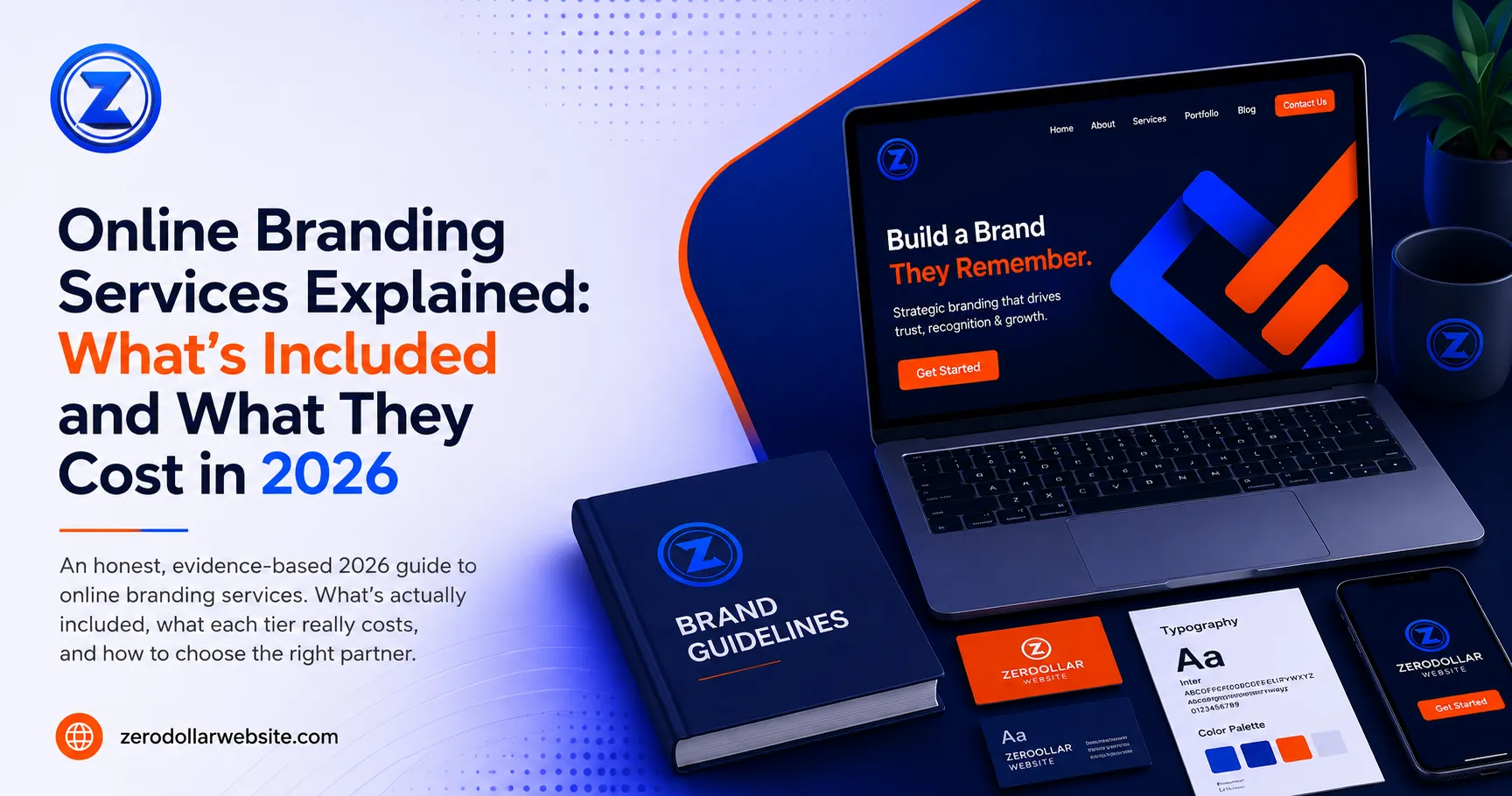
A professional logo is not a single picture. It is a small system of files, rules, and decisions that lets your brand look the same on a phone screen, a storefront window, an invoice, and a product label. When you hire a credible designer or studio, the work usually breaks into five clear stages.
- Discovery. A kickoff conversation and a written brief covering your goals, audience, competitors, voice, and any hard constraints.
- Research. A visual audit, mood boards, type explorations, and color directions. A good designer is hunting for the open space your category has not claimed yet.
- Concepts. Two to four distinct directions, each shown in a real setting such as a web header, an app icon, or packaging.
- Refinement. One chosen direction tightened over two or three rounds. Curves, spacing, color, and type all get dialed in.
- Delivery. Master vector files, exports for every common use, and a brand guideline document.
If a quote never mentions all five stages, you are buying a graphic rather than an identity. That gap matters most once the logo has to live somewhere, which for most small businesses is the website. When we build your free business website, we apply your mark and palette directly to the design, so the work you commissioned actually reaches customers instead of sitting in a folder. You can see the standard on our website examples page.
How long professional logo design takes in 2026
Timelines come down to two things: who you hire and how fast you reply. According to a 2026 breakdown by Akrivi, a small business working with a responsive freelancer can wrap in two to three weeks, while agency projects with several stakeholders tend to run four to eight weeks. Enterprise rebrands that include legal review can stretch to two or three months.
A realistic four-week schedule looks like this: week one covers discovery and mood boards, week two presents concepts, week three refines the chosen direction, and week four delivers final files plus the guideline. Reply to feedback within about 24 hours at each milestone and you can shave a full week off that schedule. Rush jobs usually carry a 25 to 50 percent surcharge, so naming your launch date on day one is cheaper than compressing the timeline later. If the logo is feeding into a new site, share that target early so the design and the build can move in step. Our pricing page shows how the free website sits alongside optional paid work.
Fair pricing: freelancer, studio, and marketplace compared
Logo pricing in 2026 spans almost three orders of magnitude, which is exactly why the topic feels so murky. The table below summarizes what to expect at each tier, drawing on US market data from DesignRush and the 2026 logo design cost report from Thervo.
| Tier | Typical price (USD) | Timeline | Best for |
|---|---|---|---|
| AI generator or DIY tool | $0 to $50 | Minutes | Placeholder only |
| Marketplace gig | $5 to $200 | 2 to 5 days | Side projects and hobby brands |
| Solo freelancer | $500 to $2,500 | 2 to 3 weeks | Small businesses and early startups |
| Boutique studio | $2,500 to $15,000 | 4 to 6 weeks | Funded startups and growing SMBs |
| Full-service agency | $15,000 to $50,000+ | 6 to 12 weeks | Rebrands and scaled businesses |
| Enterprise branding | $50,000 to $250,000+ | 3 to 6 months | Public companies and acquisitions |
Most small and mid-sized businesses land somewhere in the $1,500 to $8,000 range for custom work that holds up over time. The trick is to read the deliverables, not just the headline number. A $5,000 quote that hands over six PNG files is a very different deal from one that delivers a documented system you control. If you would rather not manage that spend piece by piece, the older fully managed subscription model still lives on our agency page, and our pricing page lays out how a free site pairs with optional branding, SEO, and marketing.
Red flags every founder should watch for
Cheap is not the same as fair, and expensive is not the same as good. These are the warning signs that come up most often.
- $5 to $50 marketplace gigs. Frequently resold templates. You may end up using a mark that another business already owns.
- Pure AI logo generators. As a 2026 analysis from Bloomberg Law explains, output created without meaningful human authorship is not eligible for US copyright protection.
- No discovery call. If nobody asks about your audience, you are buying decoration rather than strategy.
- JPEG or PNG only. Without vector source files you cannot print at large sizes or adjust colors cleanly.
- "Unlimited revisions." This usually signals a high-volume template shop, not careful craft.
- Vague ownership terms. A real contract transfers full copyright to you on final payment, in writing.
- No portfolio. If you cannot see consistent original work, you are paying for someone's learning curve.
The same patterns show up in web work, where a "$200 website" often hides template lock-in and missing source files. That is one reason we built a model where the website itself is free and the only paid work is optional growth services you choose later.
How to write a brief that gets you a great logo
The single biggest predictor of a strong result is a strong brief. The best ones cover seven things.
- Business basics. What you sell, who buys it, and your stage of growth.
- Brand personality. Five adjectives for how the brand should feel. Skip generic words like modern or clean.
- Audience. A short profile of the person you most want to attract.
- Competitors. Three to five direct rivals plus one or two brands you aspire to.
- Visual likes and dislikes. Six to ten logos you admire and three or four you reject, each with one line on why.
- Use cases. Everywhere the mark has to work: app icon, embroidery, vehicle wrap, dark interface, light interface.
- Constraints. Budget, deadline, anything that must be included or avoided, and any prior trademark filings.
If you are rebranding, also write down what is not working today. A clear one-page brief saves a surprising amount of back and forth, and it is the same discipline that makes a website project run smoothly. If marketing is next on your list, a tight brief also feeds straight into marketing and local SEO work so the message stays consistent.
The files and brand guide you should demand
According to the Akrivi designer handoff guide, every delivery should include both editable master files and ready-to-use exports. At minimum, ask for the following.
- Master vector source. AI plus EPS for broad software compatibility.
- Print-ready PDF. CMYK color space, with bleed where relevant.
- SVG. For crisp web use at any size.
- PNG exports. Transparent backgrounds, multiple sizes, light and dark variants.
- Favicon and app icon. Square crops at 16, 32, 192, and 512 pixels.
- Lockups. Horizontal, stacked, and icon-only versions.
- Color variants. Full color, single-color black, single-color white, and a reversed mark.
Alongside the files, expect a brand guideline document. Even a short ten-page version should cover logo clear space, minimum size, color values in HEX, RGB, CMYK, and Pantone, your primary and secondary typefaces, and examples of correct and incorrect use. This is what lets a future printer, developer, or social manager keep the brand consistent. It is also the reference we use when applying your identity to a free website build, so the guide pays for itself the first time someone else touches your brand.
Copyright, ownership, and trademark in 2026
Owning your logo is not automatic. There are three legal layers, and most founders only think about one of them.
- Copyright. By default the designer owns it. You own it only once your contract transfers copyright to you, which usually happens on final payment.
- Trademark. This protects the logo as a commercial source identifier within specific classes. Federal USPTO registration gives far stronger protection than the TM symbol on its own.
- Clearance. Before filing, search the USPTO database and common-law uses to confirm nothing conflicts in your category.
AI-generated marks deserve extra caution. A 2026 analysis from Taylor Wessing reaffirms that purely AI-generated output is not protected by copyright in the US or EU, because it lacks human authorship. You can still apply to trademark an AI-assisted logo, but a purely machine-made design can be copied freely. The safer path is to have a human designer use AI as one tool, make substantial creative edits, and run a clearance search before filing. In regulated fields, it is worth a conversation with an IP attorney before you launch.
Common mistakes founders make
The same errors show up across hundreds of identity projects. Avoid these and you are already ahead of most early-stage brands.
- Designing by committee. Pick one decision maker. Group voting produces compromise logos nobody loves.
- Skipping discovery. A cheap quote that skips strategy usually costs more in revisions later.
- Chasing trends. A mark built around the look of 2026 will feel dated by 2028.
- Designing only for the web. Test the mark on a t-shirt, a sign, and a favicon before you approve it.
- Forgetting accessibility. Check contrast on light and dark backgrounds and confirm legibility at small sizes.
- Ignoring the system. A logo with no typography, color rules, or usage notes is only half a brand.
- Paying in full upfront. Standard terms are 50 percent at kickoff and 50 percent on delivery, with copyright transfer triggered by that final payment.
If you want to understand how the logo and the rest of the site reinforce each other, our companion piece on how logo and website design work together walks through the connection in detail. To see finished identities in context, browse our case studies.
When to invest in a full identity instead of a logo alone
A standalone logo is fine for a contract signature or a quiet beta. The moment you have customers, marketing channels, or a real product interface, you need a brand identity system. The system is what keeps everything from your homepage to your social posts to your ad creative looking like one company. For most small businesses, that consistency first shows up on the website, which is exactly why we apply your identity directly when we build your done-for-you website and keep it current over time through our optional Concierge service. When you are ready to grow demand, pairing the visuals with marketing and local SEO is where the brand starts paying you back.
Key takeaways
- Professional logo design in 2026 runs from about $500 with a freelancer to $15,000 with a studio, and most small businesses land between $1,500 and $8,000.
- A real project includes discovery, research, concepts, refinement, and a written brand guide.
- Avoid $5 marketplace gigs and pure AI generators if you plan to trademark or scale the brand.
- Confirm vector source files, a written copyright transfer, and a usage guideline before final payment.
- Trademark clearance is separate from copyright and well worth the cost in regulated industries.
FAQ
How much should a small business spend on a professional logo in 2026?
Most US small businesses spend between $1,500 and $5,000 on a custom logo from a credible freelancer or boutique studio. That budget typically covers discovery, two or three concept directions, two rounds of revisions, standard file formats, and a basic brand guide. Spending under $500 usually means template work, while spending over $10,000 points to a fuller identity system.
How long does a professional logo design project take?
Plan for two to three weeks with a responsive freelancer and four to eight weeks with an agency. The biggest variable is how fast you give feedback. Replying within about 24 hours at each stage can save a full week. Rush projects carry a 25 to 50 percent surcharge, so starting earlier is cheaper than compressing the schedule.
What file formats should I receive from a logo designer?
Expect master vector files in AI and EPS, a print-ready PDF in CMYK, an SVG for the web, transparent PNG exports in several sizes, square favicon and app-icon crops, and color variants for light backgrounds, dark backgrounds, and single-color use. A brand guideline documenting colors, typography, spacing, and correct usage should come with the files.
Can I trademark a logo created by an AI generator?
You can apply to trademark an AI-generated logo, because trademark law focuses on distinctiveness and use in commerce rather than authorship. However, a purely AI-generated logo is not eligible for US copyright protection, which makes enforcement harder. The safer route is to have a human designer make substantial creative edits and run a clearance search before filing with the USPTO.
Who owns the logo after I pay for it?
By default the designer owns the copyright. Ownership transfers to you only when your contract says so, usually triggered by final payment. Insist on a written copyright assignment clause. If you work with an agency, also confirm that any subcontractors have assigned their rights to that agency.
Do I really need a brand guide if I only have a logo?
Yes. Even a short guide tends to pay for itself within a year. As soon as you hire a printer, a developer, or a social manager, someone other than you is using your logo. Without rules for color values, clear space, minimum size, and typography, the brand drifts within months. A ten-page PDF is enough for most early-stage businesses.
Does a free website mean a generic, templated logo?
No. The free part is the website we build and host for you. Your logo is your own asset, whether you commission it from a freelancer, a studio, or already own one. When you bring us your mark and brand guide, we apply them to the site we build so the identity you paid for shows up consistently from the first screen.
Ready to put your logo to work?
A great logo only earns its keep when customers actually see it, and for most small businesses that happens first on the website. Get your free done-for-you website and we will apply your brand to it directly, then see how the $0 build compares with optional branding, SEO, and marketing on our pricing page. For more on building a brand that lasts, keep reading the Zero Dollar Website blog.