


TL;DR
Most startups fail from building something nobody wanted, not bad code. CB Insights found 42 percent of post-mortems blamed "no market need."
Building a software MVP runs roughly $25,000 to $150,000 over 3 to 6 months. Validating the idea first costs little more than a few focused weeks.
Real validation means commitment, not compliments: a deposit, a signed letter of intent, or a click on a real pricing plan.
A free landing page is the cheapest demand test you can run, which is why we build small businesses a real done-for-you website for $0.
Build only when you have a painful problem, a reachable market, and people who put something at stake. Not a day sooner.
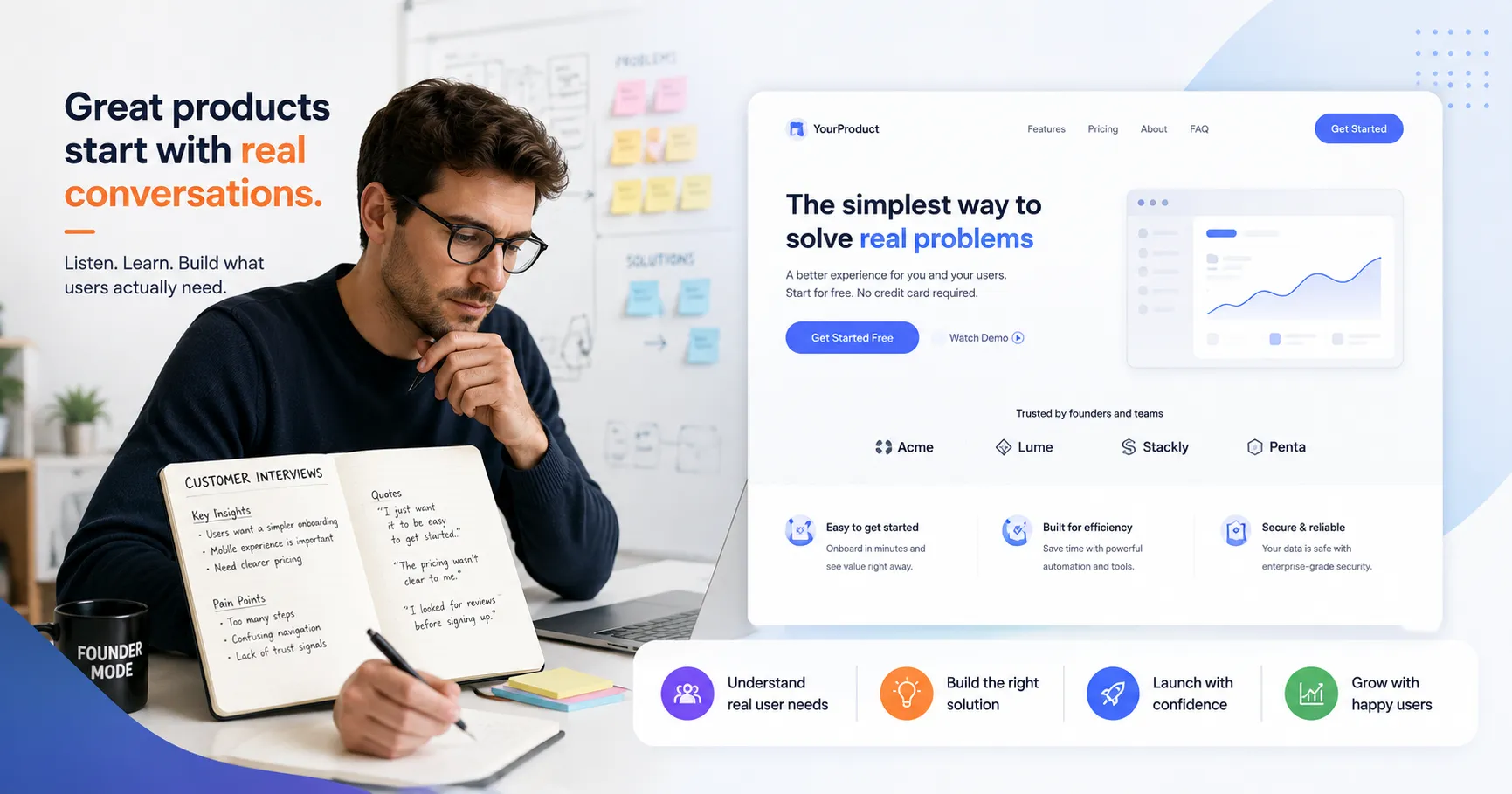
The most expensive thing you can do with an app idea is start building it. Once you commit a team to code, the meter runs whether or not anyone wants what you are making. The good news is that you can learn almost everything that matters first. This guide covers how to validate a business app idea cheaply, why a free website is the best tool for it, and when the evidence finally says build. At Zero Dollar Website we build and host your business website for $0, and that free page doubles as the cleanest demand test most founders will ever run.
Why this matters more than the idea itself
Founders fall in love with ideas. The market does not care. CB Insights' analysis of more than 100 startup post-mortems found that "no market need" was the top reason companies failed, named in 42 percent of cases, ahead of running out of cash at 29 percent. A later revision of 431 venture-backed companies that shut down since 2023 again put poor product-market fit near the top, at 43 percent. Different studies, one lesson: most businesses die because they built the wrong thing, not because they built it badly.
Now put a number on the bet. A custom software MVP typically costs $25,000 to $150,000 over 3 to 6 months. Spending that before you know anyone wants the product is the classic founder mistake, and validation is the disciplined attempt to prove yourself wrong while it is cheap to be wrong. The trap persists even after launch: Pendo's 2019 Feature Adoption Report found 80 percent of features in the average software product are rarely or never used (vendor-reported, across 615 accounts).
What validation actually means
Validating an app idea means confirming that a real, urgent problem exists and that people will pay to solve it, before you build. It breaks into three separate questions, and blurring them is the rookie error.
Problem validation: is the problem painful enough that people already spend time or money on workarounds?
Market validation: is the group with that problem large, reachable, and willing to pay enough to support a business?
Solution validation: does your approach resonate over whatever people do today?
A simple filter: separate vitamins (nice extras) from painkillers (fixes people will pay to stop). People pay for painkillers. Most founders skip straight to solution validation and never confirm the problem was real. Start with the problem.
The frameworks worth knowing
You do not need a shelf of startup books. Five sources carry the weight.
The Mom Test by Rob Fitzpatrick. Three rules for interviews: talk about their life, ask about past behavior not hypotheticals, and listen more than you talk.
The Lean Startup by Eric Ries. The build-measure-learn loop, with the MVP defined as whatever completes one full turn of it with the least effort.
Y Combinator. Talk to users, build what they want, iterate. Paul Graham's "make something people want" is the whole game.
Value Proposition Canvas by Alex Osterwalder. A one-page map of customer jobs, pains, and gains against your product. When both sides line up, you have problem-solution fit.
Jobs-to-be-Done by Clayton Christensen. People hire a product to make progress on a job. The HBR milkshake study is the canonical example.
They share one shape: learn from what customers actually do, and earn evidence before committing engineering money.
The pre-build playbook
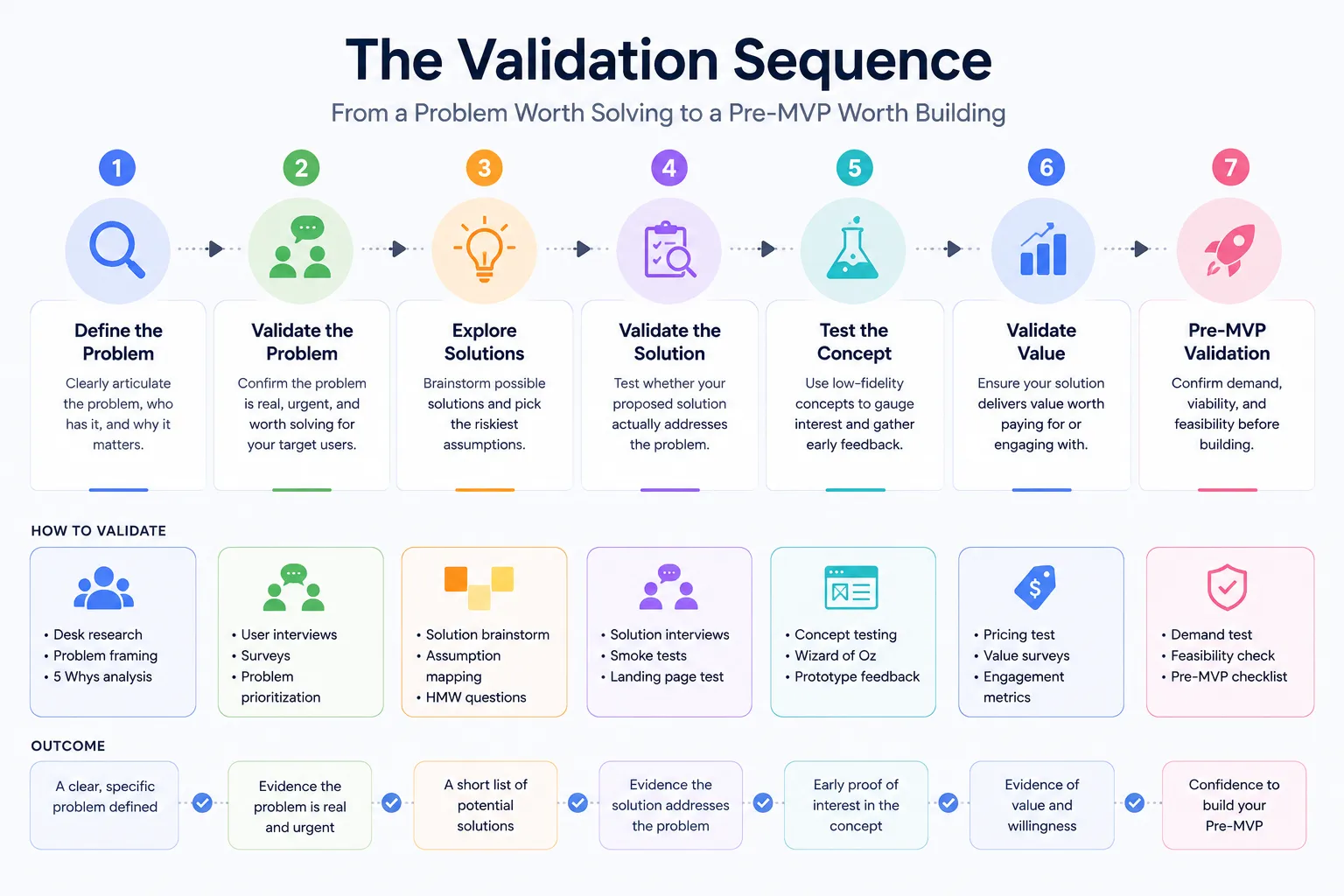
Define the problem and your customer
Write one risky-assumption sentence: "We believe that [specific customer] will pay [price] for [solution] because of [problem]." Then get specific about who hurts most, starting with the narrow group in the most acute pain.
Interview the Mom Test way, then size the market
Aim for 15 to 25 conversations with people who have the problem and no social reason to be kind to you. Nielsen Norman Group research suggests 15 to 20 interviews surface most core user needs, with diminishing returns past about 25. Ask about real past behavior ("Tell me about the last time this cost you time or money"), not hypotheticals; kill leading questions; and find out whether they have already paid for a fix, because if they never have, they probably will not buy yours. Then size the opportunity top-down and bottom-up, and avoid the "we only need 1 percent of a giant market" line investors read as a red flag.
Study the competition and the search demand
Competitors prove that demand exists; "no competitors" usually means no market rather than open territory. Look at how rivals price and position, then mine their reviews on G2, app stores, and Reddit for the complaints that reveal gaps. The same instinct shows up when you weigh a packaged tool against something built for you, the heart of our breakdown of WordPress versus a custom web app. Google Keyword Planner and Google Trends (both free) then tell you whether search interest is climbing, seasonal, or fading.
Run a smoke-test landing page
This is the heart of cheap validation. Build a single page that describes the product as if it already exists, drive a little traffic to it, and measure whether strangers take a committing action: enter an email, click a pricing plan, attempt a pre-order. Buffer is the canonical case. Joel Gascoigne put up a two-page site before writing code, added a pricing page to test willingness to pay, and per Buffer's own "Idea to Paying Customers in 7 Weeks" post (case study, company-reported) had his first paying customer within four days. The page only counts if it is built for learning, with real actions rather than a "coming soon" form. Dropbox made the same bet with a demo video that, per The Lean Startup, sent its beta waitlist from 5,000 to 75,000 overnight (case study).
Pre-sell, fake the back end, and test with small ads
The strongest validation is someone putting something at stake before the product exists. Pre-orders and refundable deposits make people prove intent with a card number; letters of intent are a B2B signal but weak next to money moving; crowdfunding doubles as a pre-sale. You can also deliver the value by hand first: a concierge MVP serves a small group manually (Airbnb's founders managed early bookings themselves), and a wizard-of-oz MVP looks automated while humans run it (Zappos founder Nick Swinmurn photographed shoes in stores and shipped them by hand, proving people would buy shoes online before building logistics, case study). Finally, a modest Google or Meta Ads budget pointed at your page reveals what interest really costs; WordStream by LocaliQ's 2026 Google Ads benchmarks put the average cost-per-click at $5.42 (vendor-reported).
Why a free website is the perfect validation tool
Here is where the Zero Dollar Website model fits the playbook almost too neatly. Nearly every step above points at the same artifact: a real page that strangers can find, react to, and commit through. The smoke test, the ad test, the waitlist, and the pricing experiment all need one, and the old friction was that building a decent one cost money or time. We build and host a real done-for-you website for $0, so your demand test is no longer a line item. Put up a clear value proposition, one committing call to action, and a pricing page, then send real traffic. If it converts, you have evidence; if it does not, you learned that for free instead of after a six-figure build. Browse our website examples to see the standard, since a free build does not mean a flimsy template.
Be clear about the limits, though. A free landing page validates demand for the offer. It does not, by itself, prove that a complex app will retain users or that your unit economics work. It is the first and cheapest gate, not the last one, so pair it with interviews and pre-sales.
Once a page is pulling interest, the optional paid services turn it into customers. Local SEO helps the right people find it, marketing drives qualified visitors to your test, and Concierge keeps it current as you iterate. None of it is required to start. Review how the free build sits next to those options on our pricing page, and if you would rather bundle everything into one managed plan, the older subscription model still lives on our agency page.
What validated actually looks like
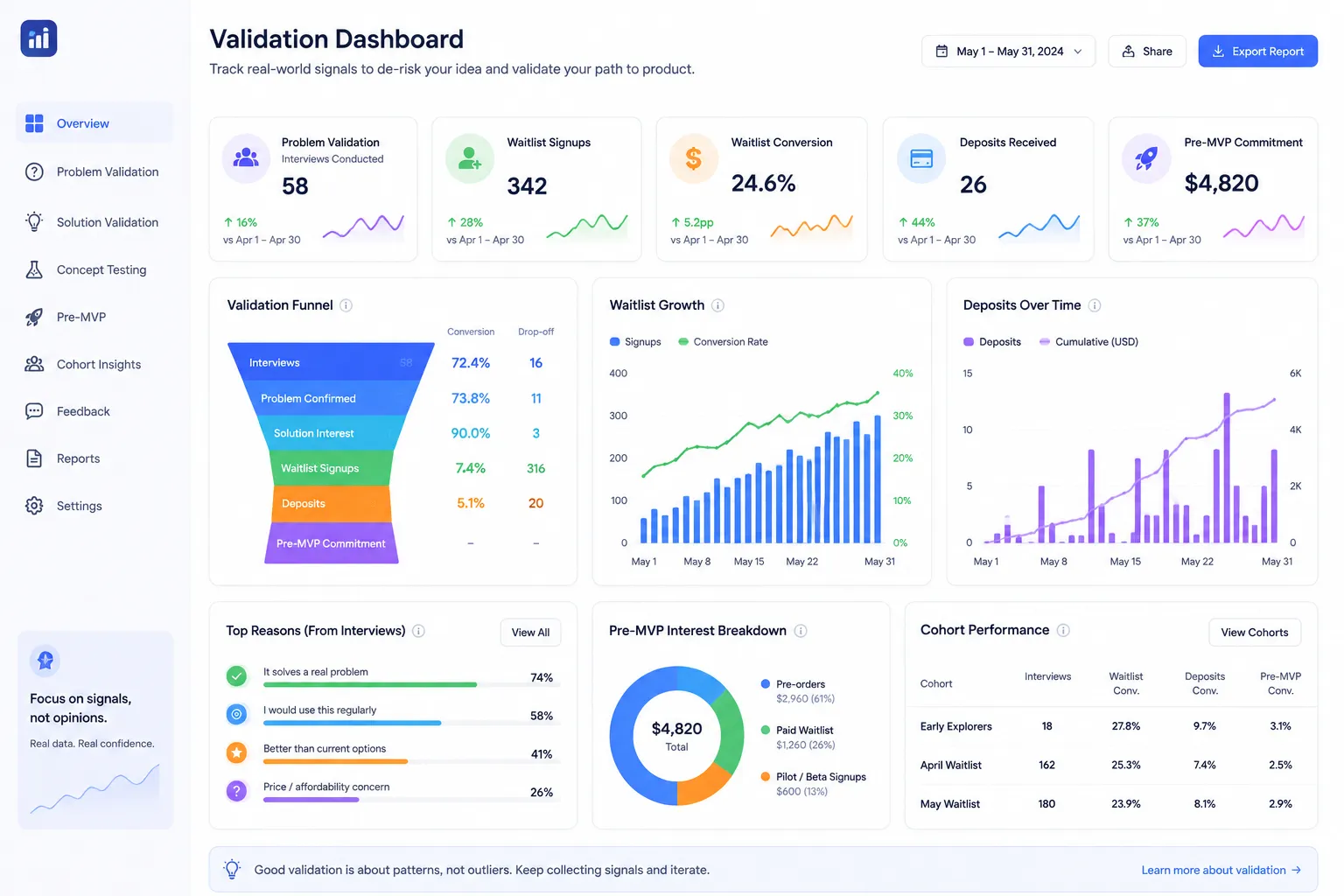
Real signals all share one trait: commitment. People take a committing action (an email on a low-friction waitlist, a click on a paid plan, a deposit, a pre-payment). In interviews they describe an active, painful problem and the money or time they already spend working around it, and they ask "when can I buy this?" instead of "cool idea." In B2B, a decision-maker with budget signs a letter of intent or simply pays. The biggest variable is how much commitment the action demands: an email is easy, a pre-order is not, which is why it tells you more.
The false signals are the ones that feel like progress without commitment: "that's a great idea" comments, social likes, visits with no conversions, and big email lists where nobody tried to pay.
The mistakes that quietly kill validation
Confirmation bias. Hunting for evidence that you are right. Real validation tries to disprove the idea, so set kill criteria before you start ("if we do not land 10 pre-orders by a set date, we stop").
Leading questions. "Would you use a tool that saves you five hours a week?" hands the person the answer you want.
Mistaking interest for intent. Compliments are not commitments. Force a real action from strangers, not friends.
Cherry-picking enthusiasts. Building for the three who loved it and ignoring the seventeen who shrugged. Weight lukewarm feedback heavily.
Analysis paralysis. Validation can become procrastination. Time-box it to two to four weeks.
When you are ready to build
You have validated enough when you can honestly check four boxes: a real, painful, recurring problem confirmed by multiple strangers; a market large and reachable enough to support a business; demonstrated demand with commitment (a converting smoke test, deposits, pre-orders, signed letters of intent, or money in hand); and a clear "why now." That is the moment to scope a lean MVP, the smallest version that solves the core problem. Resist feature creep; Buffer launched with one feature. The same signals that proved demand are the traction early investors look for, so validate first, scope tight, then build.
A four-week plan you can actually run
Week 1 (problem and customer, about $0). Write your risky-assumption sentence and customer profile, run 15 to 25 Mom Test interviews with strangers who have the problem, and search Reddit, Indie Hackers, and niche communities for people venting about this exact pain.
Weeks 1 to 2 (market and demand, about $0). Size your market top-down and bottom-up, check Keyword Planner and Trends, and mine competitor reviews for gaps. Green light: steady or rising search volume and a few growing rivals.
Weeks 2 to 3 (smoke test, about $50 to $300). Stand up a clear page with one committing call to action. Since the page can be a free done-for-you website, the only spend is a small ad budget. Aim for roughly 10 percent on a low-friction email call to action; persistent results under 2 to 3 percent are a warning.
Weeks 3 to 4 (commitment, about $0). Add a pricing page and test willingness to pay, chasing paid pilots or deposits over unpaid letters of intent. If the evidence clears the bar you set in advance, scope a lean MVP and build. If not, pivot and rerun the cheapest test. Killing a bad idea in four weeks is a win.
Key takeaways
Most failed startups built something nobody needed (42 percent per CB Insights). Validation disproves that risk before you spend on code.
Validate the problem, the market, and the solution separately. Most founders skip the problem, and that is the root error.
Real validation is commitment (money, a deposit, a signed letter of intent), never compliments.
A free landing page is the cheapest demand test there is, which is why a $0 done-for-you website is such a natural first step.
Build only when the evidence clears a threshold you set in advance, then scope tight around the core job.
FAQ
How long should validating an app idea take?
Time-box it to two to four weeks. Open-ended validation drifts into procrastination, so set kill criteria (commitment thresholds and dates) before you start.
How many customer interviews do I actually need?
Aim for 15 to 25. Nielsen Norman Group research suggests 15 to 20 surface most core needs, with diminishing returns past about 25. Talk to strangers, not friends.
Can a free website really validate an app idea?
It validates demand for the offer, the first and cheapest gate. A clear page with one committing call to action measures whether strangers will act, and a free done-for-you website removes the cost of the test. It does not prove retention or unit economics on its own, so pair it with interviews and pre-sales.
What is the difference between problem validation and solution validation?
Problem validation asks whether a real, painful problem exists and whether people already try to solve it. Solution validation asks whether your approach resonates. Most founders jump to solution first, which is backwards.
How much should I spend on validation?
Mostly your time: $0 for interviews, market sizing, and competitor research, plus $50 to $300 for a small ad budget aimed at a page that can itself be free. Compare that to the $25,000 to $150,000 cost of an unvalidated MVP.
Is competition a bad sign for my idea?
Usually the opposite. Competitors prove demand exists and that people pay. "No competitors" more often means no market. Study how rivals price and position, mine their reviews for gaps, then point what you learn at a live test page.
When is it time to bring in a development team?
When you have a painful, recurring problem confirmed by multiple strangers, a defensible market, and people who put something at stake through deposits, pre-orders, paid pilots, or signed letters of intent. Then scope a lean MVP around the core job.
What counts as a false validation signal?
Anything that feels like progress without commitment: "great idea" comments, social likes, visits with no conversions, and praise from friends and family. Force a real action, then trust what people do over what they say.
The teams that ship products customers actually pay for share one habit: they earned evidence before they wrote code, and the cheapest place to earn it is a real page on the open internet. Get your free done-for-you website, point a little traffic at it, and let real strangers tell you the truth. When you are ready to scope the build behind it, compare the $0 site with optional support on our pricing page. Prove the demand first, then build what it asked for.