

TL;DR
- Branding is a system, not a logo. It covers positioning, name, visuals, voice, and the guidelines that hold it together.
- In 2026, small business budgets fall into three bands: do-it-yourself ($0 to $1,500), freelance ($1,500 to $8,000), and agency ($8,000 to $30,000+).
- Per Marq (formerly Lucidpress), consistent brand presentation is linked to roughly a 10 to 20 percent revenue uplift, and a widely cited Lucidpress study reported up to 33 percent.
- Always get source files, font licenses, color tokens, and a brand guide before final payment, or you do not really own your brand.
- Refresh every 3 to 5 years. Rebrand only when your strategy or audience has genuinely changed.
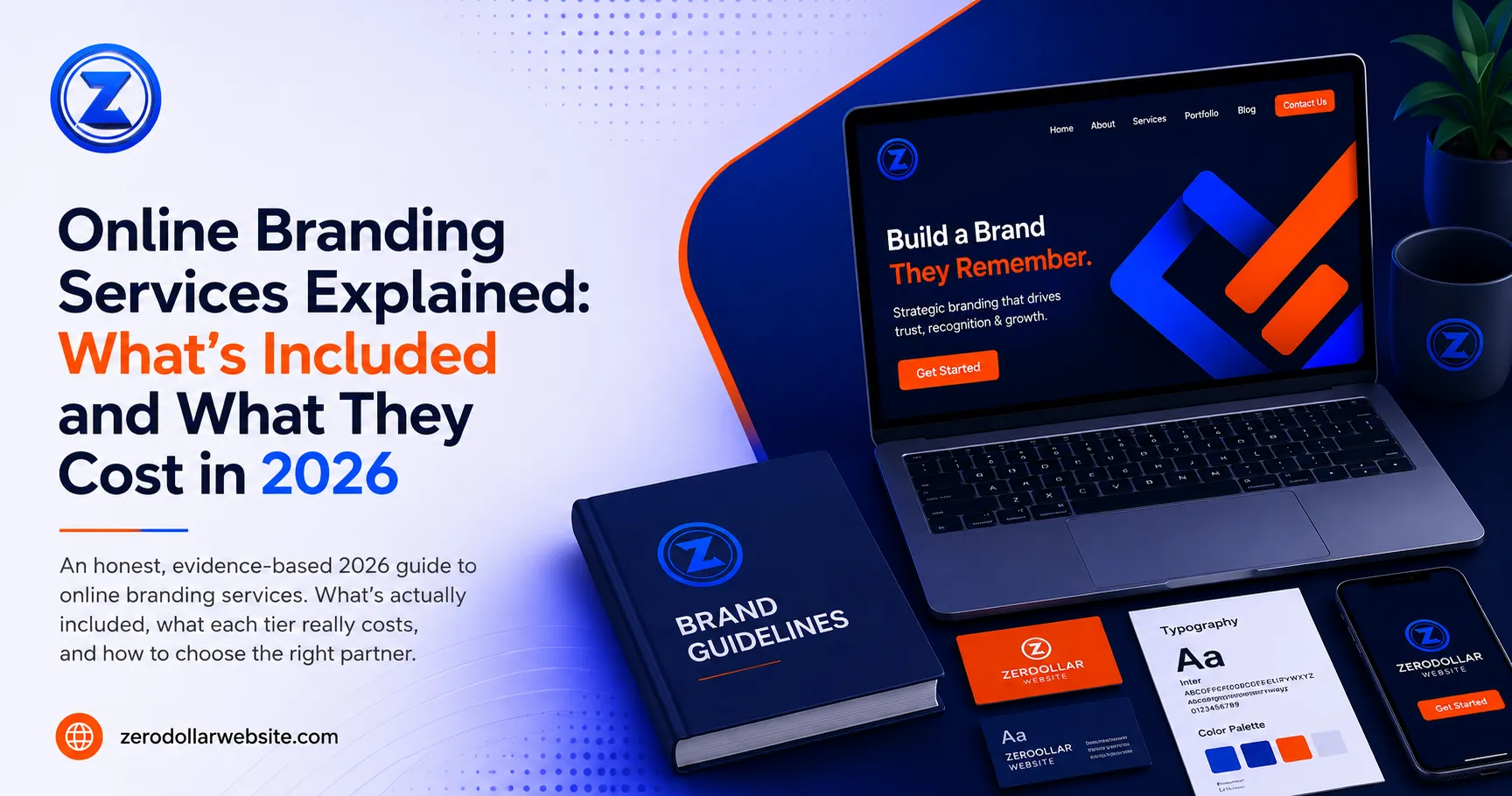
Branding stopped being optional for small businesses a while ago. A customer compares you against polished competitors in about two scrolls, and the trust signals on your site decide whether they reach out or leave. This guide breaks down what branding actually includes in 2026, what it should cost, and how to avoid the traps that quietly drain a small budget. At Zero Dollar Website we build your business website for free, and a clear brand makes that site work harder, so it pays to understand the moving parts before you spend anything.
What branding actually includes in 2026
Most owners walk in asking for a logo. What they need is a brand system with a few connected layers, and skipping any of them is the reason cheap branding tends to fall apart within a year.
- Positioning: who you serve, the problem you solve, and why someone should pick you over the next option.
- Name and verbal identity: business name, tagline, key phrases, and tone of voice.
- Logo system: a primary mark, secondary marks, a favicon, and lockups for different placements.
- Color and typography: a defined palette with hex, RGB, and CMYK values, plus a properly licensed type pairing.
- Imagery: photo direction and illustration style so everything looks like it came from the same place.
- Brand guidelines: a document that records all of the above so the next person who touches your brand does not redesign it by accident.
If all you have is a logo file and no documented system, you have a graphic, not a brand. The same identity should carry straight onto your website, which is why we apply your brand directly when we build your done-for-you site rather than bolting it on later.
What small businesses actually need versus nice to have
Budgets are finite, so separate the deliverables that compound in value from the ones that look good in a slide deck and never get used.
Need first:
- A positioning statement and a one-line description of what you do.
- A logo in vector formats (SVG, PDF, EPS) plus PNG exports.
- Two or three brand colors with accessible contrast.
- Heading and body typography with proper licenses.
- A short brand guidelines document, usually 10 to 20 pages.
- A social profile kit: avatars, banners, and a couple of post templates.
Nice to have later: a custom illustration or icon set, a brand video, a photography style guide, packaging, or a pitch deck template if you are raising money. If a proposal pushes these before the foundations are locked, push back. Foundations first. When you are ready to grow the brand once the basics are in place, that is where paid services like marketing and local SEO add the most.
Realistic 2026 price tiers
Pricing has settled into clear bands. The figures below reflect industry surveys from Shopify, Clutch, and DesignRush, and they are planning estimates that vary by scope and region.
| Tier | Typical price (USD) | Timeline | Best for |
|---|---|---|---|
| DIY and template | $0 to $1,500 | 1 to 2 weeks | Pre-revenue side projects, proof of concept |
| Freelance designer | $1,500 to $8,000 | 3 to 6 weeks | Solo founders, local services, single-product brands |
| Boutique or full-service agency | $8,000 to $30,000+ | 6 to 12 weeks | Funded startups, multi-channel businesses, rebrands |
| Enterprise brand system | $30,000 to $100,000+ | 3 to 6 months | Mature businesses expanding to new markets |
Shopify reports small business packages running from a few hundred dollars up to around $10,000 for a full identity, while Clutch shows agency engagements often starting near $5,000. The honest read for most small businesses is that $5,000 to $15,000 buys the right balance of polish and longevity, and a vetted freelancer can deliver a solid foundation for less. You can see how the free website fits alongside paid growth services on our pricing page.
What you get at each tier
A price without a deliverables list is meaningless. A $5,000 quote that hands over six files is very different from one that delivers a documented system. Use this as a checklist when you read any proposal.
| Deliverable | DIY / template | Freelance | Agency |
|---|---|---|---|
| Positioning workshop | No | Sometimes | Yes |
| Logo concepts presented | 1 template | 2 to 3 | 3 to 5 |
| Logo source files (SVG, PDF, EPS) | Sometimes | Yes | Yes |
| Color palette with tokens | Basic | Yes | Yes, with accessibility specs |
| Typography with licensing | Free fonts only | Yes | Yes, web and print |
| Brand guidelines | No | 10 to 15 pages | 20 to 60 pages |
| Social media kit | Limited | Yes | Yes, with templates |
| Web-ready assets and favicon | Sometimes | Yes | Yes |
Get this in writing before you pay a deposit. If you are building a site at the same time, the brand system should feed straight into it. That is exactly how our website build works, and you can browse finished results on our website examples page to see the standard.
Timeline and how to brief a designer
A realistic small business branding project takes between 3 and 12 weeks. Anything promised in 48 hours is templated, and anything past 16 weeks usually means the scope was never properly defined. A typical phased timeline looks like this:
- Discovery (week 1): a short workshop, a competitor scan, and a look at your audience.
- Strategy (week 2): positioning, messaging, and mood boards.
- Design (weeks 3 to 6): logo concepts, color, typography, and mockups.
- Refinement (weeks 6 to 8): revisions, accessibility checks, and file prep.
- Guidelines and handover (weeks 8 to 10): the brand document, the asset library, and a walkthrough.
To brief a designer well, hand over your goals for the next 12 months, three competitors you respect, three brands outside your category you admire, your main customer segments, and any non-negotiables. A one-page brief saves a surprising amount of back and forth.
Deliverables to demand: files, licenses, and tokens
This is where projects quietly fail. The work looks great in the presentation, then six months later you cannot edit anything and your printer asks for a file that does not exist. Demand the following before final payment:
- Logo source files: editable vectors (SVG, PDF, EPS) plus PNG exports on transparent backgrounds.
- Color tokens: hex, RGB, CMYK, and Pantone if you print.
- Typography licenses: proof of purchase or the open-source license name. "Free for personal use" is not the same as commercial.
- Brand guidelines: a PDF plus an editable source.
- Working files: the original Figma or Illustrator file, not just exports.
- Usage rights: a written transfer letting you use the work commercially without restriction.
If anyone refuses to hand over the source files, walk away. Owning your assets is the difference between a brand you control and one you rent.
The cost of getting branding wrong
Cheap branding is rarely free in the end. Research from Marq (formerly Lucidpress) on brand consistency found that brands presenting themselves the same way across every channel see roughly a 10 to 20 percent revenue uplift, and a widely cited Lucidpress study reported up to a 33 percent revenue increase for fully consistent brands. The most expensive mistakes we see are trademark conflicts found after launch, logo files delivered only as PNGs, free fonts that actually needed a commercial license, and trend-driven looks that feel dated within 18 months.
Per Bynder, the average rebrand touches around 215 assets and takes roughly seven months, so getting it right the first time is far cheaper than redoing it. If you are pairing branding with a new site, our guide to how the Zero Dollar Website model works explains how the free build keeps that joined-up budget low.
Your website is where the brand lives
A brand system only earns its keep when people actually see it, and for most small businesses the first and most frequent place that happens is the website. Your homepage hero, your colors, your type, and your voice all show up there before a customer ever walks in or calls. If the site looks generic or off-brand, the work you paid for in a brand guide never reaches anyone.
This is the part we handle for free. We build and host your done-for-you website and apply your brand to it directly, so the identity you invested in is consistent from the first screen. If you would rather have a fully managed plan with the brand and growth work bundled together, the older subscription model still lives on our agency page. Either way, browse our website examples to see the standard the brand should be held to.
Rebrand or refresh?
Not every brand needs a full rebrand. A refresh updates the visual system while keeping the foundation. A rebrand changes the foundation itself, which is more expensive and riskier.
Choose a refresh when your logo feels dated but recognition is strong, you are entering a new channel, your colors or type are not accessible, or you want to modernize without confusing existing customers. Choose a rebrand when your audience has materially changed, you are merging or pivoting, the name no longer fits the offer, or negative associations are blocking growth. Be cautious either way, since many rebrands cause a short-term dip in recognition, so start with a strategic audit before any visual work.
How to tell your branding is working
Brand results are not as squishy as people claim. Within about 90 days you should see movement on a few signals: more people searching your name directly, a higher conversion rate on your homepage, a lower cost per lead from paid channels, faster sales conversations, and more referrals. Pair the visual work with marketing and local SEO to amplify it, and keep the site current with Concierge so the brand stays consistent as you grow. Real outcomes show up in our case studies.
Key takeaways
- Branding is a system, not a logo. Budget for strategy, visuals, and guidelines together.
- For most small businesses, $5,000 to $15,000 hits the right polish and longevity balance in 2026.
- Get source files, font licenses, and a brand guide in writing before final payment.
- Refresh every 3 to 5 years. Rebrand only when strategy or audience has truly shifted.
- Pair the visuals with a strong website and marketing to see real returns inside 90 days.
FAQ
How much should a small business spend on branding in 2026?
For most small businesses, a realistic budget is $5,000 to $15,000 for a foundational system covering positioning, logo, color, typography, and guidelines. Solo founders can start as low as $1,500 with a vetted freelancer. Funded or multi-location businesses often invest $15,000 to $40,000 for a system that scales across channels.
Is a branding agency worth it over a freelancer?
It depends on scope. A freelancer is great for a single deliverable and usually costs two to four times less. An agency earns its price when you need strategy, several disciplines, and a documented system that survives team turnover. If your brand will touch a website, social, packaging, and ads, an agency often wins on total cost of ownership.
How long does a typical branding project take?
Plan for 3 to 6 weeks with a freelancer and 6 to 12 weeks with an agency. Discovery is 1 to 2 weeks, design and revisions are 3 to 6 weeks, and guidelines plus handover add another 1 to 2 weeks. Anything promised in days is templated, and projects past 16 weeks usually mean unclear scope.
What files should I receive at the end?
You should receive editable vector logos (SVG, PDF, EPS), high-resolution PNG exports, a color palette with hex, RGB, and CMYK values, licensed typography with proof, a brand guidelines document, the original working files, and a written transfer of usage rights. If any are missing, you do not fully own your brand.
When should I rebrand instead of refresh?
Rebrand when your audience, business model, market position, or name has fundamentally changed. Refresh when the strategy still holds but the execution feels dated. Most small businesses need a refresh every 3 to 5 years and a full rebrand only once a decade. Rebrand too often and you reset the recognition you spent years building.
Can I use AI tools to brand my small business?
AI tools are useful for early exploration, naming brainstorms, and quick mockups. They are not yet reliable for trademark-safe logos, licensed typography, or a coherent system. The strongest 2026 approach blends AI for ideas with a human for synthesis, legal checks, and craft.
Ready to put a real brand behind your business? Start with a professional site at no cost. Get your free done-for-you website today, and see how the $0 build compares with optional branding, SEO, and marketing services on our pricing page. A clear brand on a fast site is what turns a visitor into a customer.